
OTAR® Ammonia Recovery Technology
Turn Nitrogen Into Revenue, Not Just Compliance Cost
Proven thermal ammonia recovery for anaerobic digesters, CAFOs, wastewater treatment plants, food & beverage processors, and landfills across the U.S.
In practice, OTAR® technology transforms a treatment cost into a value-recovery opportunity. It recovers nitrogen as ammonium hydroxide, ammonium sulfate, or anhydrous ammonia. At the same time, it cuts operating costs versus biological treatment and meets tightening nitrogen discharge limits — all from a single modular platform engineered around your site’s waste heat, ammonia load, and target market.
Key Facts
PROBLEMS WITH WASTEWATER AMMONIA IN THE U.S.
Why Excess Ammonia Is Becoming a Costly Liability for U.S. Operators
Landfill sites, intensive livestock operations, AD/biogas developers, and food and beverage processors across the U.S. are facing the same pressure. In fact, ammonia loads are expensive to treat, increasingly regulated, and in almost every case, destroyed rather than recovered.
Rising Treatment Costs
High ammonia concentrations increase the cost of digestate handling, wastewater treatment, and surcharge exposure for high-strength dischargers.
- ✔ Increasing OPEX
- ✔ Greater management complexity
- ✔ Risk of permit violations and penalties
Tightening EPA Discharge Limits
Overall, discharge limits under NPDES permits, state nutrient management rules, and CAFO regulations are becoming stricter across the U.S.
- ✔ Stricter discharge limits
- ✔ Greater regulatory pressure
- ✔ Rising sustainability requirements.
Lost Resource Value
Every kilogram of ammonia destroyed by BNR is fertilizer lost. Instead, OTAR® recovers nitrogen as ammonium hydroxide or ammonium sulfate for reuse or local sale.
- ✔ Ammonia recovery instead of destruction
- ✔ New revenue opportunities
- ✔ Greater nitrogen valorization
INDUSTRIAL NITROGEN RECOVERY
What Is OTAR® Ammonia Recovery Technology?
In short, OTAR® (Organics Thermal Ammonia Recovery) is a modular, thermally-driven ammonia stripping and recovery system. It uses waste heat, or an integrated heat-recycling loop where none exists, to shift the ammonia equilibrium in wastewater or leachate. As a result, the system strips ammonia gas out of solution and captures it as ammonium hydroxide, ammonium sulphate fertiliser, or safely destroy it thermally. Unlike biological nitrogen removal, OTAR® is a physical process, not a living microbial culture, making it more predictable and resistant to shock loads.
Why OTAR®?
Ammonia Recovery
In practice, OTAR® Recovers ammonia present in digestate and wastewater and converts it into a reusable product.
Ammonium Product Generation
At the same time, depending on site requirements, OTAR® produces ammonium hydroxide, ammonium sulphate, or anhydrous ammonia.
Treatment Cost Reduction
Consequently, OTAR® reduces nitrogen treatment and effluent management costs.
Circular Economy Value
In addition, it converts a waste stream into a resource, supporting circularity and sustainability goals.
Typical Operating Range
- NH₄-N concentration: 500–10,000 mg/L
- Ammonia removal: 95–98.5%
- Recovered products: Up to 25% ammonium hydroxide or ammonium sulfate fertilizer
- Heat source: 90–95°C low-pressure steam or hot water
- Electrical demand: 0.15–0.25 kWh/m³ treated
Recovering Nitrogen or Simply Eliminating It: Which Is the Best Option?
In fact, conventional nitrogen treatment carries an ongoing cost with no return. OTAR® ammonia recovery turns that same cost into a recovered fertilizer product and a lower operating spend.
⚙️ Conventional Treatment
- Ammonia is destroyed as biological waste
- Ongoing aeration, carbon dosing & sludge disposal costs
- No product is recovered
- Vulnerable to toxic shock loads and process upset
- Requires acid, alkali or salt by-product handling
- No direct economic return
🌿Recovery with OTAR®
✓ Ammonia recovered as a usable product
✓ Ammonium hydroxide or ammonium sulphate fertiliser output
✓ Approx. 0.45 GBP/kg-N vs 2.95 GBP/kg-N for BNR
✓ Physical process, resistant to shock loads
✓ Preferred configuration needs no acid, no salt waste
✓ Full EPC delivery, proven 20+ years
HOW IT WORKS
How Ammonia Stripping & Recovery Works
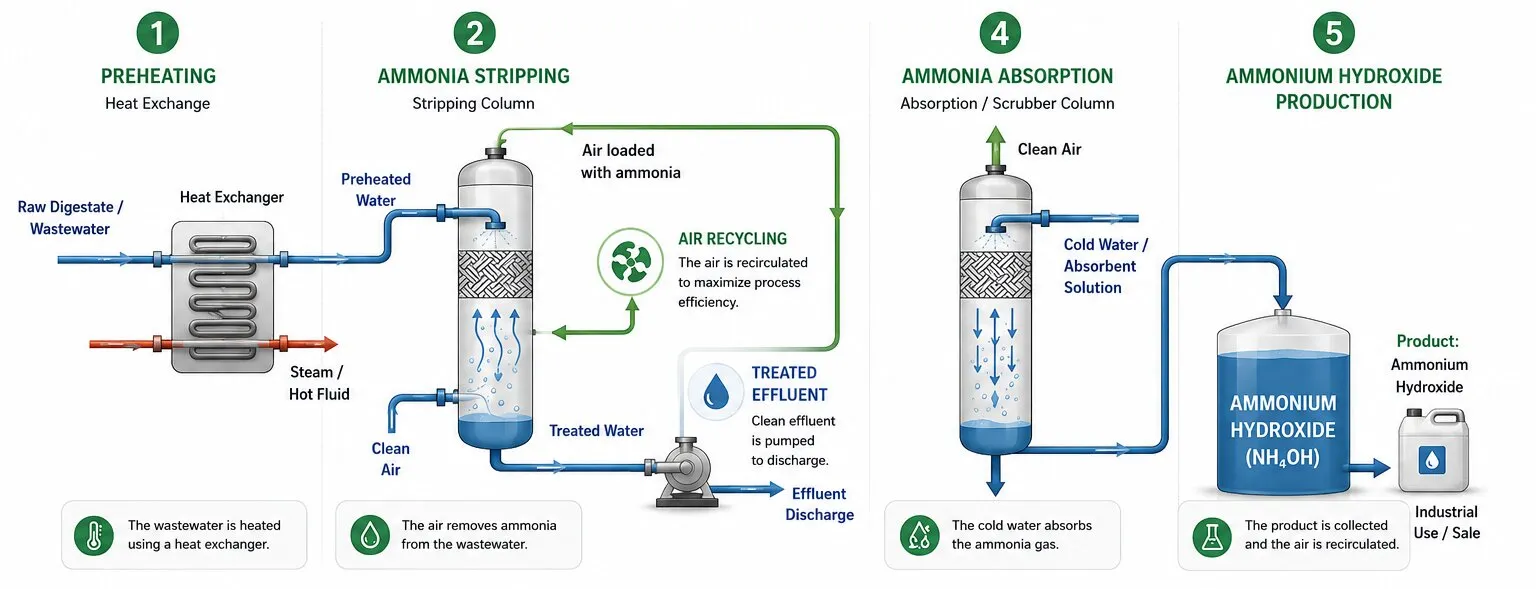
1. Influent Intake
First, ammonia-laden leachate, digestate or trade waste enters the system already carrying ionised ammonium (NH4+) in solution.
2. Equilibrium Shift
Then, the waste heat (or heat-recycling electricity) raises temperature and/or pH, shifting the chemical equilibrium toward free ammonia gas (NH3).
3. Stripping Column
The liquid is distributed over structured packing while steam or hot air strips ammonia from the liquid phase into the gas phase, typically achieving 85–99% TAN removal.
4. Absorption & Recovery
Lastly, the ammonia-rich gas is absorbed into water (ammonium hydroxide), reacted with sulphuric acid (ammonium sulphate), or thermally destroyed to nitrogen gas and water vapour.
FIVE CONFIGURATIONS
One Platform, Adapted to Your Site and Product Market
OTAR®’s modular design lets it prioritize product recovery or straightforward compliance, depending on project goals, available waste heat, and local product markets.
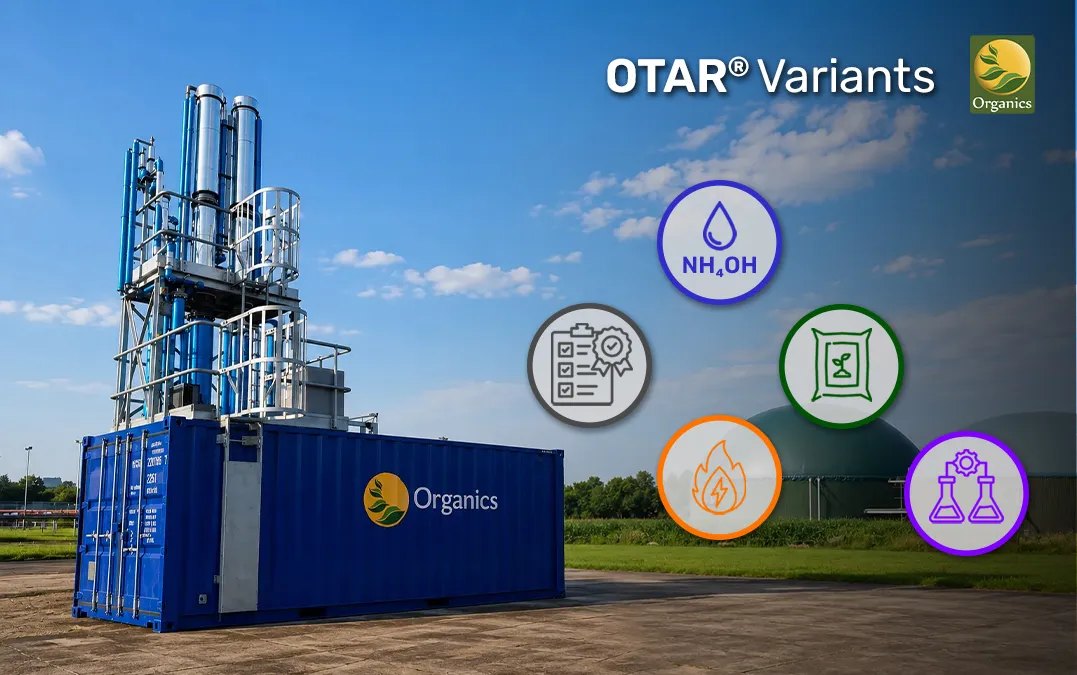
Ammonium Hydroxide Recovery — Waste heat strips ammonia into an OMRI-eligible ammonium hydroxide product, with no acid or salt waste. Best fit: organic-market AD/biogas developers.
Ammonium Sulfate Recovery — Reacts stripped ammonia with sulfuric acid into a liquid or crystalline fertilizer sold through ag co-ops. Best fit: CAFOs and Midwest food processors.
Anhydrous Ammonia Recovery — Further concentration yields anhydrous ammonia for fertilizer, refrigeration, or hydrogen-carrier use. Best fit: sites with existing anhydrous storage/offtake.
Thermal Destruction (No Recovery) — Oxidizes stripped ammonia to nitrogen gas and water vapor for compliance-only sites. Best fit: landfills and WWTPs without a product market.
pH-Driven Conversion — Raises pH to strip ammonia without high heat, feeding any recovery or destruction route. Best fit: sites without reliable waste heat.
VARIOUS INDUSTRY APPLICATIONS
Built for America’s Highest-Intent Ammonia Challenges
Municipal Wastewater Utilities
In this case, OTAR® can treat dewatering centrate and other high-strength sidestreams at the source to reduce nitrogen loads, lower energy and chemical demand, and support discharge compliance.
Commercial AD, Biogas & Organic Waste
For co-digestion plants, food waste processors, and agricultural biogas facilities. In this setting, OTAR® removes TAN from digestate or centrate, protecting biogas production while recovering valuable ammonia products.
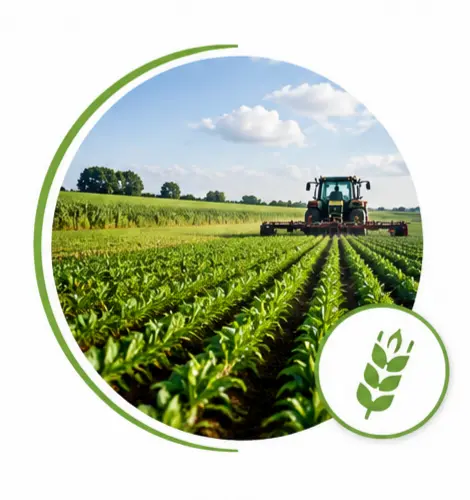
Agriculture & Livestock (Dairy & Swine CAFOs)
Here, it reduce nitrogen from manure and digestate while producing marketable ammonium sulfate fertilizer or ammonium hydroxide to support nutrient management.
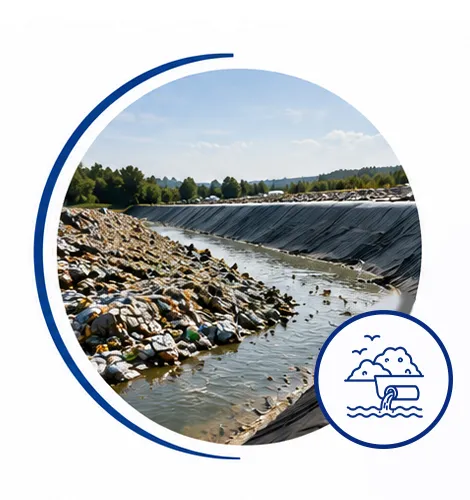
Industrial Wastewater & Landfills
Ideal for landfill leachate, meat processing, dairy, rendering, fermentation, and other high-nitrogen industrial wastewater. Here, OTAR® reduces discharge costs, improves compliance, and recovers nitrogen as a valuable product.
OTAR® IN OPERATION
OTAR® Proven Performance
In fact, Organics Group’s OTAR® platform has more than 20 years of continuous operational history. For example, these two projects illustrate the range, from a two-decade-old industrial installation to some of the largest ammonia recovery deployments in the world.
Case Study: OTAR® Thermal Ammonia Recovery, Australia
- Commissioned: March 2002
- Design flow: 12.5 m³/hr
- Influent ammonia: 1,875 mg/L NH3/NH4
Outcome: Reduced ammonia to compliant discharge levels, protecting downstream biological assets and avoiding regulatory penalties — now in its third decade of continuous operation, avoiding over 20 years of rising chemical costs versus chemical-dosing alternatives.
West New Territories (WENT) Landfill, Hong Kong
- Application: Landfill leachate treatment
- Influent ammonia: up to 6,700 mg/L NH4-N
- Flow: 1,000–2,300 m³/day
Outcome: OTAR® consistently reduced ammonia to <100 mg/L, stabilizing downstream treatment and enabling compliance with stringent nitrogen discharge limits across multiple expansion lines at the same site. As a result, this is directly relevant to U.S. landfill operators evaluating TAN removal at comparable scale.
COST COMPARISON
OTAR® vs Conventional Nitrogen Removal
| Technology | Typical Cost | Chemical Use | Carbon & Compliance Impact |
|---|---|---|---|
| OTAR® (Thermal Ammonia Recovery) | ≈0.45 GBP/kg-N | Waste heat, no caustic/acid | Avoids N₂O emissions, supports EPA/ State compliance |
| pH-Adjusted Thermal Stripping | ≈1.30 GBP/kg-N | Requires caustic & acid | Moderate GHG reduction, higher OPEX |
| Biological Nitrification–Denitrification (BNR) | ≈2.95 GBP/kg-N | Aeration & carbon source | Generates N₂O (~300× CO₂ warming), high energy demand |
| Anammox Biological Process | ≈2.25 GBP/kg-N | Sensitive biological process | Lower energy than BNR, still emits some N₂O |
Note: Cost benchmarking from Organics Group project data across comparable high-strength nitrogen removal installations, converted to USD at current exchange rates. Actual costs require a project-specific estimate.
What Determines the Return on an OTAR® Installation?
| Factor | Impact on Return |
|---|---|
| Ammonia concentration | Higher concentration = greater recoverable value per m³ treated |
| Flow rate treated | Higher flow increases total recoverable nitrogen volume |
| Available waste heat | On-site waste heat (biogas engines, landfill gas, process heat) sharply reduces energy cost; Variant 4 heat recycling achieves a coefficient of performance exceeding 15 where none exists |
| Current treatment cost | The higher your existing BNR or chemical-dosing spend, the greater the potential saving |
| Local off-take market | Access to a local fertiliser buyer or in-house reuse increases the value of the recovered product |
💡 Every site is different
Our team runs a technical assessment against your specific flow, concentration and heat availability before recommending a configuration.
See What OTAR® Could Recover On Your Site
Based on the cost and performance data above, most operators want to know one thing next: what would this look like for us? Run your numbers with our team.
FREQUENTLY ASKED QUESTIONS
We answer the most common questions about ammonia recovery
Find answers to the most common questions about OTAR® technology, ammonia recovery, and its industrial applications.
How much ammonia can OTAR® remove?
OTAR® typically achieves 95–98.5% ammonia removal, treating feedstock concentrations from 500 mg/L up to 10,000 mg/L NH4-N. To demonstrate, this has been proven at influent concentrations as high as 6,700 mg/L NH4-N at the West New Territories landfill in Hong Kong.
Is OTAR® cheaper than biological nitrogen removal (BNR) in the U.S.?
Based on Organics Group’s project cost benchmarking, OTAR® thermal ammonia recovery costs approximately $0.61 per kg of nitrogen treated. By comparison, conventional biological nitrogen removal costs approximately $3.97 per kg-N. This difference is largely due to OTAR® using waste heat instead of continuous aeration, external carbon dosing, and biological sludge disposal.
Can OTAR® treat CAFO manure and digestate?
Yes, OTAR® is deployed at large-scale dairy and swine CAFOs to recover ammonia from liquid manure and digestate. In doing so, it converts a nutrient management liability into ammonium sulfate or ammonium hydroxide that can be reused on-site or sold to local agriculture.
Does OTAR® require hazardous chemicals?
the preferred configuration (water absorption) uses no acid and produces no salt waste. Consequently, operators avoid ongoing acid deliveries and hazardous chemical handling, setting it apart from conventional acid-scrubbing ammonia removal systems.
Can Organics USA deliver OTAR® as a full EPC solution?
Yes. Organics USA, part of the Organics Group, delivers OTAR® as a full engineering, procurement, and construction (EPC) solution, from feasibility assessment and detailed design through to build, commissioning, and long-term operational support.
How long has OTAR® been proven in the field?
OTAR® installations include a landfill leachate project that has run continuously since March 2002 (Project Q3000). In addition, multiple ongoing installations across Hong Kong and the UK treat 3,000–6,700 mg/L NH4-N. After all, Organics has been demonstrating over 20 years of continuous operational history.
Didn’t find your answer? Ask our OTAR® specialist directly