by Angelina | Jul 17, 2026 | Ammonia recovery, Ammonia removal,, blog
With over 20 years of operational experience and proven installations across Asia, OTAR delivers trusted ammonia recovery solutions. Its five-variant platform serves U.S. anaerobic digestion operators, CAFOs, municipal wastewater plants, food and beverage processors, and landfill operators. To achieve optimal efficiency, every system is designed for each site’s waste heat availability, ammonia load, and end-product market.
Ammonia, measured as Total Ammoniacal Nitrogen (TAN), is one of the most expensive challenges in organics management. High TAN levels inhibit methanogens in anaerobic digesters, while increasing chemical and aeration costs at wastewater treatment plants. Furthermore, these high concentrations trigger wastewater surcharges for industrial dischargers and continue to persist in landfill leachate for decades. OTAR® ammonia recovery technology treats TAN as a recoverable nitrogen asset, not a compliance cost. OTAR is a modular platform that adapts to each site.
One Platform, Built for Five U.S. Industries
OTAR® was engineered around a simple reality: no two facilities have the same ammonia problem. Biogas developers, dairy CAFOs, municipal plants, food processors, and landfill operators all generate high-ammonia streams. Each requires a different balance of energy, chemical use, and product output. Here is how the platform maps to five industries facing the toughest ammonia and nitrogen challenges in the United States today.
Co-digestion plants, food waste processors, and agricultural biogas developers often process high-nitrogen feedstocks.
Ammonia toxicity can occur before digesters reach their organic loading limit. OTAR® removes TAN from digestate or centrate before it inhibits methanogenesis. This protects biogas yield and creates a second revenue stream from recovered ammonium products.
Mega-dairies and swine CAFOs generate enormous volumes of liquid manure and digestate, and nutrient management compliance is only getting stricter. OTAR® converts a permitting and land-application liability into a marketable crop fertilizer. It turns a compliance cost center into a revenue stream
Dewatering centrate and other high-strength sidestreams contain a large share of a plant’s nitrogen load. They return this nitrogen to the headworks for repeated treatment. Treating ammonia at the source with OTAR® reduces energy, chemical, and aeration demand. This helps plant superintendents and municipal engineers meet tighter nitrogen discharge limits.
Meatpacking, dairy processing, fermentation, and rendering plants often discharge high-strength nitrogen effluent. Many face significant municipal wastewater surcharges, especially across the Midwest. OTAR® strips ammonia on-site, cutting surcharge exposure and, depending on the configuration selected, producing a saleable ammonium product.
Landfill leachate carries heavy, persistent TAN loads that conventional biological treatment struggles to handle economically over the life of a site. OTAR® offers municipal and private waste management operators a long-term, low-maintenance ammonia treatment pathway suited to leachate’s variable flow and concentration.
Five Variants, One Adaptable Platform
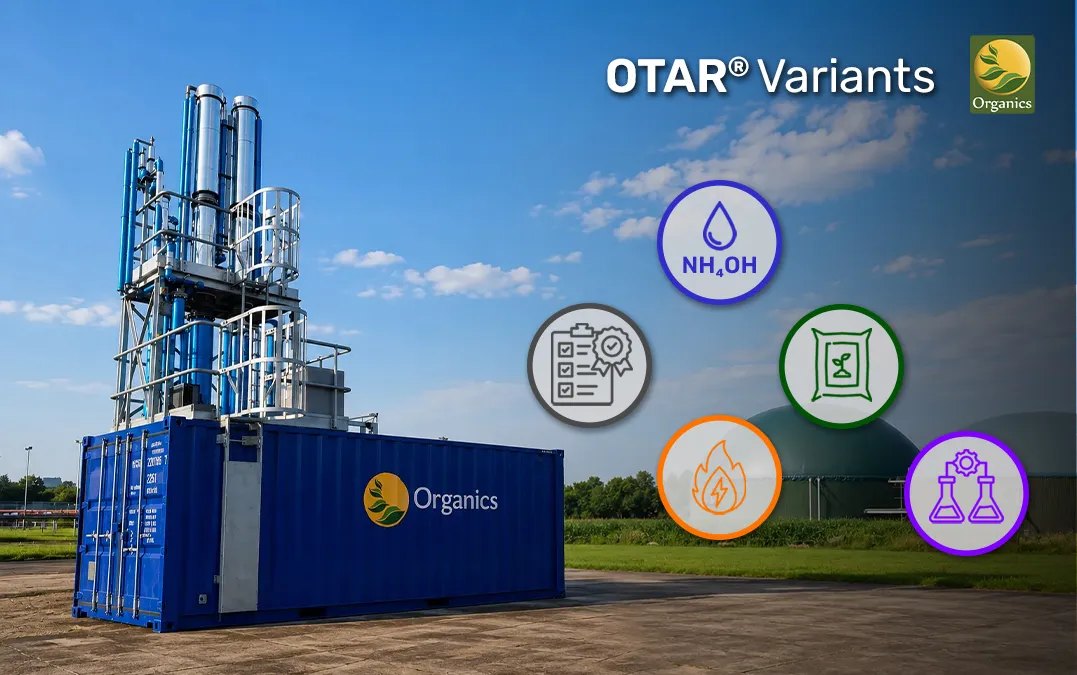
Understanding OTAR® starts with understanding its modularity. Unlike single-purpose ammonia treatment systems, OTAR® is a flexible platform. It adapts to site conditions across all five target industries.
Variant 1
Waste Heat with Thermal Destruction
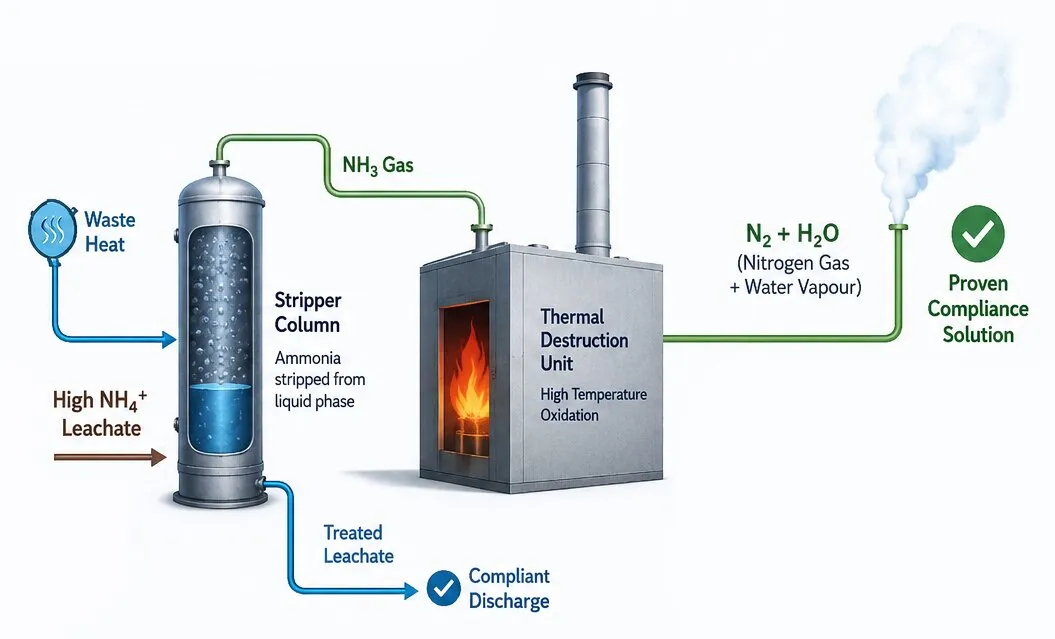
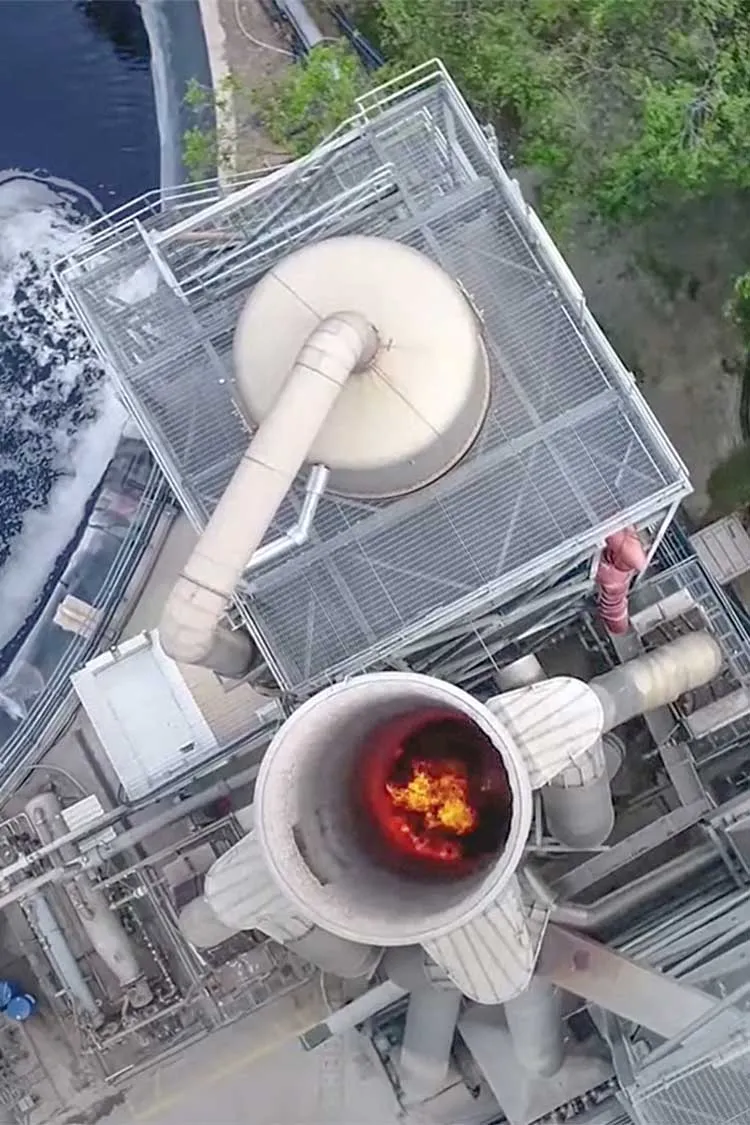
Where ammonia recovery is impractical, OTAR® uses waste heat to strip ammonia from the liquid phase. The ammonia gas is thermally oxidized into nitrogen gas and water vapor. No product recovery is required.
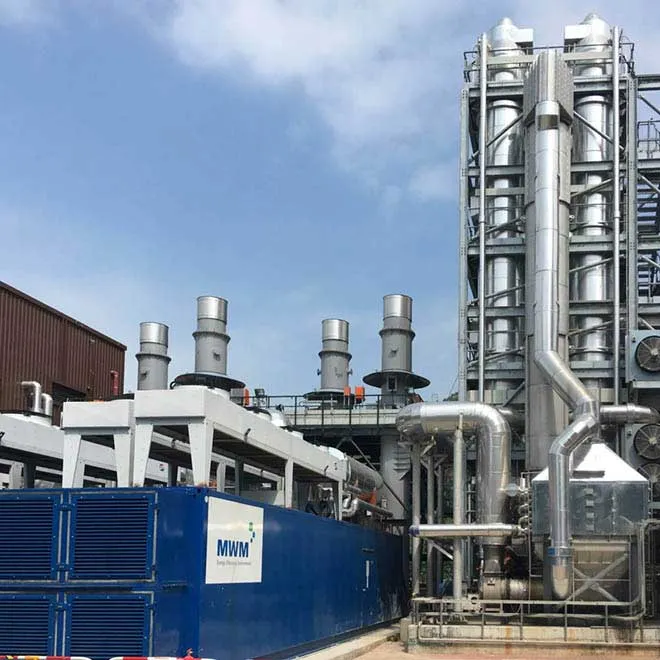
This is a proven compliance solution used at multiple Hong Kong leachate treatment facilities. Waste heat from biogas engines and landfill gas powers ammonia stripping. The system meets strict nitrogen discharge limits without downstream chemical handling. As a result, it’s a natural fit for U.S. landfill operators and municipal WWTPs that need reliable TAN removal from leachate or centrate without adding a product line. The trade-off is clear: compliance is achieved, but no product revenue is generated.
Variant 2
Waste Heat to Recover Ammonium Hydroxide
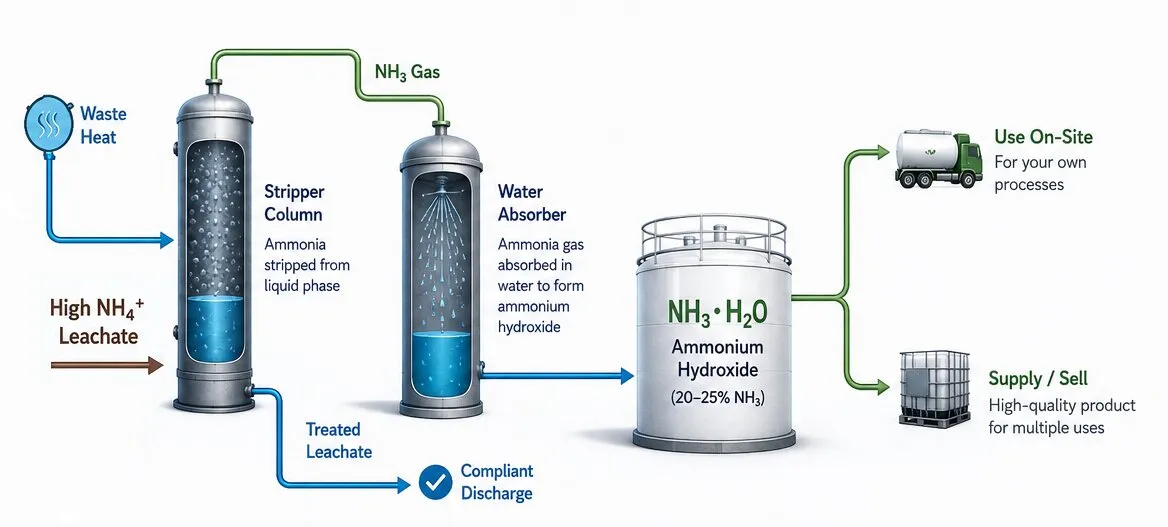
OTAR® Variant 2 prioritizes ammonia recovery using available waste heat. Recovered ammonia gas is absorbed into water to produce ammonium hydroxide. The product typically contains 20–25% NH₃.
The process uses no acid and generates no salt waste. Consequently, this makes the product eligible for OMRI Listing. Conventional acid-absorption systems cannot achieve this certification. It is a key advantage for AD and biogas developers serving organic fertilizer markets. A chemical manufacturing plant integrated this OTAR® variant into its process. It produced ammonium hydroxide for onsite use.
The plant reduced external ammonium hydroxide purchases by nearly one-third. With further concentration, the same system can produce anhydrous ammonia for fertilizer, refrigeration, or hydrogen-carrier applications.
Variant 3
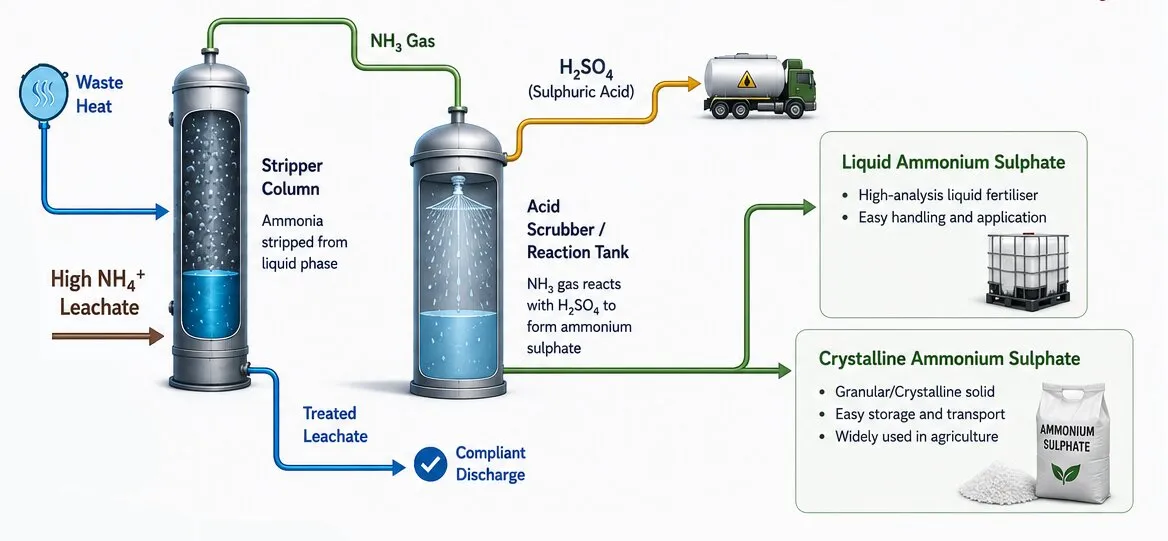
Waste Heat to Recover Ammonium Sulphate
OTAR® Variant 3 suits agricultural regions with strong demand for sulfate fertilizer. It reacts stripped ammonia with sulfuric acid to produce ammonium sulfate. The product is available as liquid fertilizer or crystalline solid. This pathway is especially attractive for large-scale dairy and swine CAFOs and high-protein food processors that can move product directly through farming cooperatives, where sulfuric acid is readily available at competitive cost.
The advantage is a stable, widely recognized product with established markets. However, the trade-offs are the need for a reliable acid supply chain and meeting agricultural quality standards; this variant does not produce OMRI-eligible product.
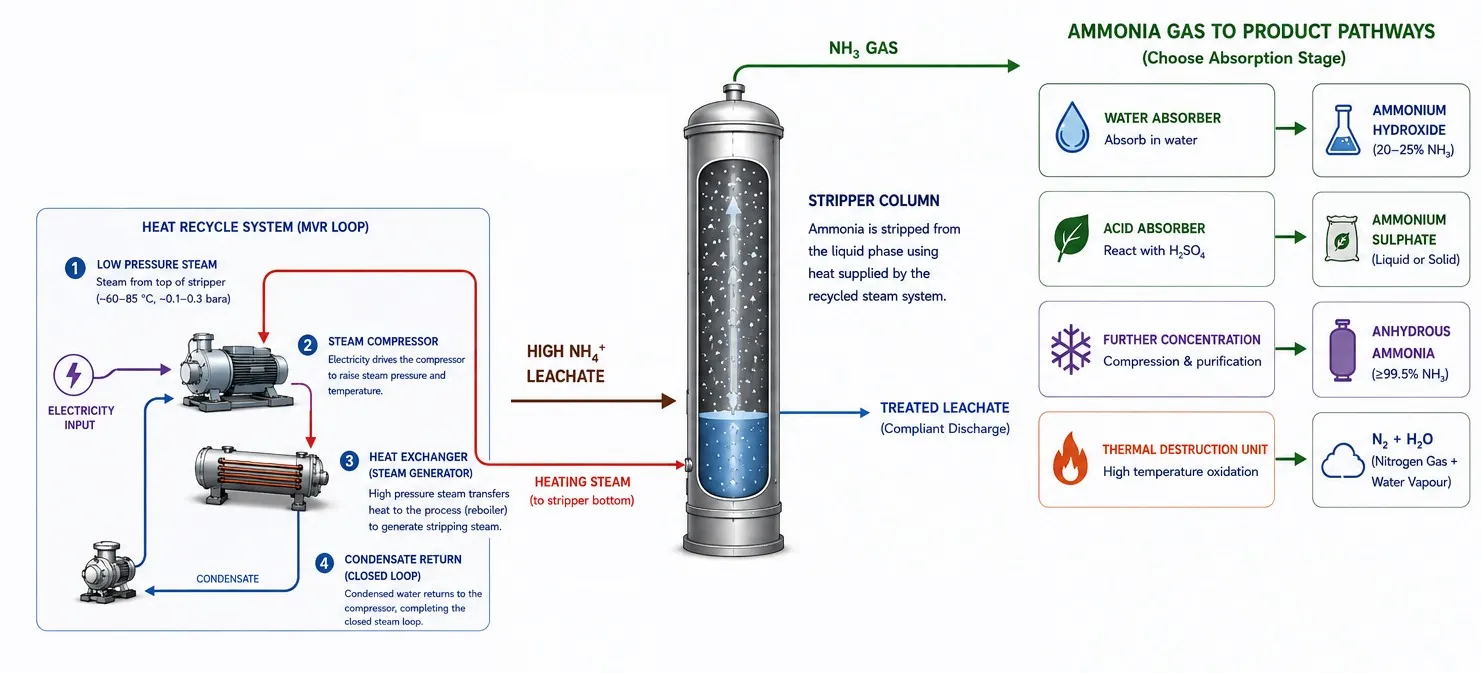
For sites without reliable waste heat, Variant 4 uses electricity to drive a heat recycling system that compresses and recycles steam to generate the thermal energy needed for stripping. The coefficient of performance exceeds 15 meaning 15 or more units of stripping heat are delivered per unit of electrical energy consumed.
Variant 4 is compatible with every product pathway above: thermal destruction, ammonium hydroxide, anhydrous ammonia, or ammonium sulfate, depending on the absorption stage selected. It is particularly well suited to remote CAFOs, standalone digesters, and seasonal food and beverage processors with fluctuating waste heat availability.
Variant 5
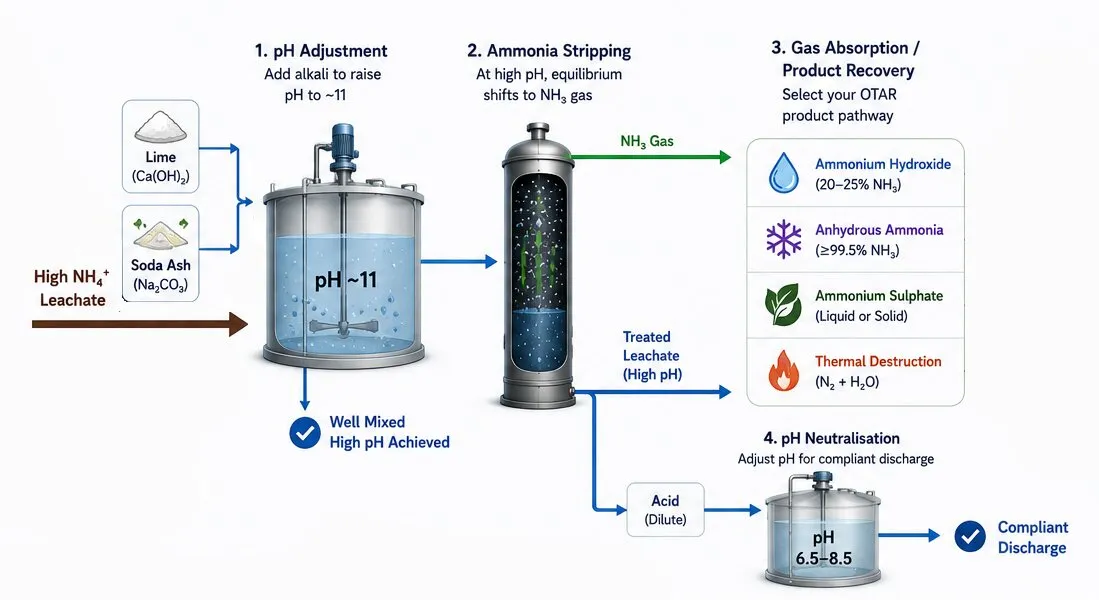
pH-Driven Conversion
Where waste heat is in short supply, ammonia stripping can be driven instead by raising wastewater pH to around pH 11 using an alkali base such as lime or sodium hydroxide (soda ash). At elevated pH, the equilibrium shifts toward free ammonia gas without requiring high temperatures, enabling stripping at ambient or moderately elevated conditions; where some heat is available alongside pH adjustment, the chemical requirement can be reduced proportionally.
Additionally, this variant is fully compatible with all OTAR® product recovery routes and suits landfill operators and municipal WWTPs where bulk chemical supply is straightforward and low-maintenance operation matters most. The trade-offs are ongoing alkali cost and the need to adjust pH back down after stripping for discharge compliance.
Frequently Asked Questions
How do I stop ammonia inhibition in an anaerobic digester?
Remove TAN from digestate or centrate before it accumulates to inhibitory levels — OTAR®’s waste-heat and heat-recycling variants (1, 2, and 4) are designed for exactly this, protecting biogas yield while recovering a marketable ammonium product.
How can a dairy or swine CAFO turn manure into a fertilizer revenue stream?
OTAR® Variant 3 converts stripped ammonia into ammonium sulfate, a stable, widely recognized fertilizer that can move directly through agricultural cooperatives — turning a nutrient management liability into a locally marketable product.
How do municipal WWTPs reduce ammonia treatment costs from centrate?
Treating dewatering centrate or other high-strength sidestreams at the source with OTAR® removes TAN before it returns to the head of the works, reducing the energy, chemical, and aeration load on secondary biological treatment.
How can food and beverage processors cut high-strength nitrogen surcharges?
On-site OTAR® ammonia stripping treats high-strength nitrogen effluent before discharge, reducing exposure to municipal surcharges and, in configurations with a recovery stage, generating a saleable ammonium byproduct.
What technology removes ammonia (TAN) from landfill leachate?
OTAR® Variant 1 (thermal destruction) and Variant 5 (pH-driven conversion) are both proven, low-maintenance pathways for treating the heavy, persistent TAN loads typical of landfill leachate over the long operating life of a site.
Assess Your Wastewater Treatment & Recovery Potential with Organics!
Fill out a short questionnaire and let our team review your specifications, calculate estimated chemical and thermal requirements, and schedule a direct consultation with an Organics specialist.
by Angelina | Jun 19, 2026 | Ammonia recovery, Ammonia removal,, blog
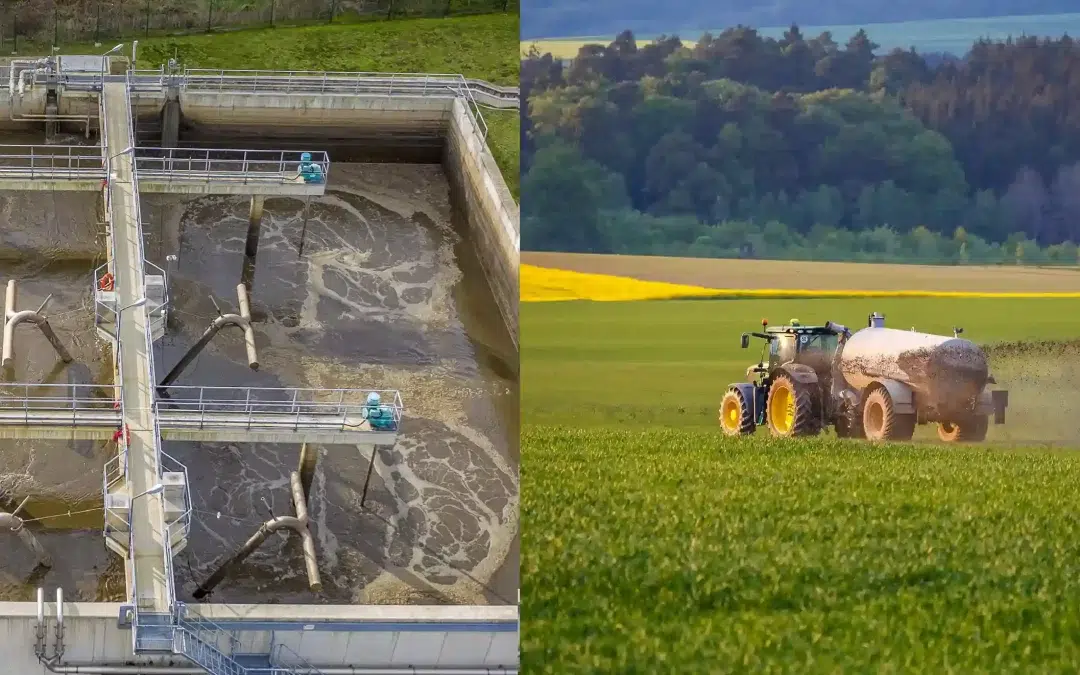
For every ton of ammonia destroyed by traditional Biological Nitrogen Removal (BNR), facility operators sacrifice immense amounts of energy, expensive chemicals, and capital. At the same time, they throw away a vital nutrient that the agricultural and commercial fertilizer industries value at hundreds of dollars per ton.
In the United States, as the Environmental Protection Agency (EPA) tightens nutrient discharge limits for municipal and industrial facilities, continuing with business-as-usual nitrogen destruction is becoming a major financial liability.
What Is Biological Nitrogen Removal?
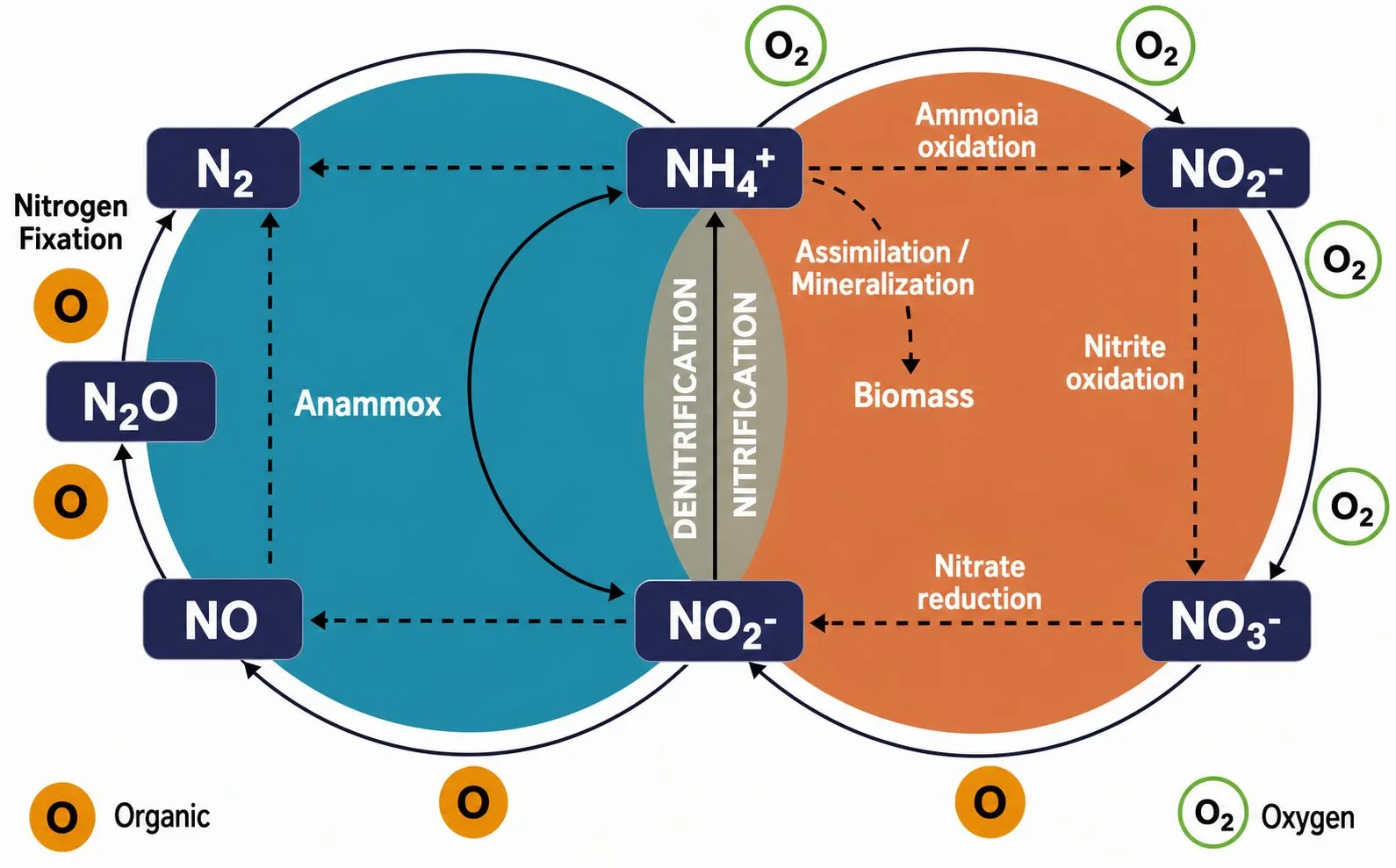
Biological nitrogen removal (BNR) is the multi-stage process where ammonia in wastewater, industrial streams, or anaerobic digestate is converted first to nitrate (nitrification) and then to nitrogen gas (denitrification) via specialized microbial activity.
Through this process, the nitrogen simply vents into the atmosphere. While regulatory compliance under the National Pollutant Discharge Elimination System (NPDES) is technically achieved, the underlying operational costs keep climbing.
For decades, BNR has served as the default engineering solution for ammonia treatment.
The biological process is well understood, state regulatory approvals are standard, and the infrastructure is proven. However, as US energy grids face rising volatility and facilities navigate stricter decarbonization mandates, environmental engineers are asking a fundamental question:
Is destroying nitrogen really the best use of resources?
The Energy Burden on US Infrastructure
Nitrogen destruction is inherently energy-intensive. BNR requires massive, continuous aeration to keep nitrifying bacteria alive. In typical domestic and industrial wastewater treatment plants (WWTPs), aeration already represents the single largest consumer of electricity on-site, frequently accounting for 40% to 60% of a facility’s total energy footprint.
This issue multiplies when dealing with high-strength ammonia streams, such as reject water from anaerobic digestion. This is a critical pain point in the United States, where the rapid expansion of agricultural waste-to-energy projects—particularly those handling poultry waste and chicken manure—generates digestate with exceptionally high ammonia concentrations.
Treating poultry-heavy digestate via BNR demands massive oxygen transfer rates, oversized blower systems, and a staggering amount of grid power.
The Hidden Operational Costs Beyond Electricity
The true cost of operating a traditional BNR system extends far beyond the utility bill:
Denitrification requires a volatile organic carbon source (typically methanol or acetic acid) when the incoming Biochemical Oxygen Demand (BOD) is too low. This adds thousands of dollars in recurring chemical expenditures.
Nitrification naturally destroys alkalinity. To prevent process failure and maintain pH stability, operators must continuously dose expensive additives like lime, caustic soda, or sodium bicarbonate.
BNR generates a massive biological floc. This secondary sludge must be thickened, chemically dewatered, hauled, and landfilled—directly increasing tipping fees and the facility’s Scope 1 and Scope 3 carbon footprint.
Traditional BNR requires extensive real estate for large aeration basins, anoxic tanks, and secondary clarifiers. For existing US plants facing space constraints, physical expansion is often cost-prohibitive.
Keeping nitrifiers and denitrifiers balanced requires highly skilled operators, continuous analytical monitoring, and constant adjustments to counter toxicity or temperature drops.
The Ultimate Waste: Destroying Commercial Value
Perhaps the most overlooked drawback of BNR is that it destroys a high-value commodity. The global fertilizer market relies heavily on nitrogen, while the emerging clean energy sector increasingly views ammonia as an essential hydrogen carrier. Facilities executing BNR are, in effect, paying to destroy a resource with severe market demand.
High-Ammonia Waste Streams
➔
Traditional BNR
➔
Atmospheric Loss $0 Value / High Energy Cost
High-Ammonia Waste Streams
➔
OTAR® System
➔
Recovered Ammonium Hydroxide High-Value Asset
Through advanced recovery, high-strength streams like poultry digestate can be transformed into recovered ammonium hydroxide. When processed correctly, these recovered nutrients can fulfill criteria for circular economy initiatives, providing local agricultural regions with a sustainable source of liquid nitrogen fertilizer.
For commercial farms looking to satisfy strict environmental supply chain requirements or produce high-value crops, recovering these nutrients aligns perfectly with modern sustainable agriculture practices.
A Direct Solution: Organics Thermal Ammonia Recovery (OTAR®)
OTAR® (Organics Thermal Ammonia Recovery), developed by the Organics Group, offers a closed-loop alternative to traditional biological destruction. Instead of relying on sensitive microbial populations and costly aeration, the OTAR® platform utilizes thermal energy—often tapping directly into low-cost waste heat from on-site biogas combined heat and power (CHP) engines—to strip ammonia out of the liquid phase and capture it.
Why US Facility Managers are Turning to OTAR®:
- Modular & Scalable: The system is built on a compact, skidded footprint that integrates seamlessly into existing industrial infrastructure or agricultural biogas plants without expanding real estate.
- Adaptable Outflows: Where local agricultural off-take markets exist, OTAR® captures the nitrogen as commercial-grade ammonium hydroxide. In regions without an immediate fertilizer buyer, the system can efficiently destroy the ammonia thermally using the same on-site waste heat—eliminating the need for aeration entirely.
- Proven Reliability: Moving away from BNR does not mean adopting an unproven risk. The OTAR® technology brings over two decades of successful, large-scale international operational history to the US market.
Nitrogen is a valuable resource, and treating it as a waste product is no longer economically viable.
Up Next in This Series: We will break down the exact financial metrics, quantifying the dollar value of the ammonia leaving your facility every day—and calculate the precise ROI of capturing it on-site.
Assess Your Wastewater Treatment & Recovery Potential with Organics!
Fill out a short questionnaire and let our team review your specifications, calculate estimated chemical and thermal requirements, and schedule a direct consultation with an Organics specialist.

by Admin | Jan 9, 2024 | Ammonia recovery, Ammonia removal,
Ammonia, an Abundant Natural Element
Within the solar system, there is an abundance of ammonia spread throughout the planets. Astrogeologists estimate there are approximately 220 million km2 of sub-surface ammonia-water oceans on 14 solar system moons as well as the planet Pluto. One ocean on Titan, the largest moon of Saturn, is estimated to have a surface area of 80 million km2. On Earth, oceans cover 361 million km2, but none are composed of ammonia.
Sources of Ammonia on Earth
On Earth, there are no ammonia oceans, but copious quantities are produced each year. It is estimated that the total non-manufactured production of ammonia is some 290 million tonnes per year (tpy). Of this total, approximately 130 tpy derive from humans and livestock. Non-industrial ammonia production is augmented by the Haber-Bosch process which is the source of a further 200 million tpy.
One of the primary naturally occurring sources of ammonia originates from the decay of organic matter. Ammonia forms during the degradation of amino acids within acidogenesis. It also forms part of the excreta cycle of humans and animals as the kidneys secrete ammonia to neutralize excess acid. Consequently, it is a commonly encountered water pollutant.
To many wastewater engineers, ammonia in water represents a problem that costs money to fix. If a carbon source is required to treat the ammonia, as food for anoxic bacteria, annual costs can run into the millions.
Ammonia is also recognized as being toxic to fish. Lethal concentrations range from 2.5 to 25 mg/I. Further, as ammonia is biologically oxidized to nitrate, it exerts an oxygen demand on the receiving water. This can reduce the oxygen in the water to a point where aquatic life forms cannot survive. Ammonia also acts as a fertilizer causing the profuse growth of stringy bacteria and/or fungi and generally disrupting the natural environment.
In this article, Dr. Robert Eden discusses the latest innovations in the technology for the separation of ammonia from wastewater and landfill leachate.

by Christopher Eden | Feb 17, 2022 | Ammonia removal,
Wastewater management can be complicated. A principal reason is that excessive ammonia concentration in wastewater can cause issues with odor and the ability to clean and reuse the water. If it is not removed before release to the environment, it is highly toxic for aquatic life.
Ammonia is increasingly recognized as a compound that, whilst being highly polluting if released to the environment untreated, can also be recovered and thus represent a viable commercial resource. Using waste heat as the basis for ammonia removal and recovery meets the combined objectives of ensuring a long-term sustainable two-pronged solution to the challenges of ammonia pollution and the recycling of waste material; this latter is one of the defining tenets of the circular economy.
The principle of using heat to separate ammonia from landfill leachate is being successfully applied in Hong Kong. On this large landfill site, leachate is highly ammoniated, containing up to 8000 mg/l. As the site produces so much landfill gas, this is used to heat the leachate before separation in the stripping towers. From there, the ammonia concentration is reduced to <150mg/l and is treated by the adjacent sequence batch reactors before release outside the boundary of the landfill site. The site produces up to 9 tons of ammonia a day.